Google Plus, Facebook, Twitter... so many places to post stuff, but I just can't seem to figure out what goes where! Ok so here's how I see it: short, quick updates, or interesting things about not-super-personal issues go on Twitter. Longer, more personal things go on Facebook. Smarty pants kinda things go on Google Plus. I'm still trying to figure out where blogs fit into all of this, so I guess they just get the longer TLDR stuff. I suppose the TLDR COULD go into FB Notes or G+, but not everyone really wants to skim through that to get to the newest whatever.
So for now, my longer random thoughts and stuff will just go here and sit quietly where they may or may not be read from time to time. At least its quiet here.
Tuesday, January 24, 2012

Sunday, May 23, 2010
Week in Review (May 19-23)
After 2nd Platoon finished their Team Certifications, 1st Platoon was busy packing forJRTC. Not wanting to be behind, 2nd Platoon quickly caught up and packed quickly.
Packing was made even more complicated by the last minute notification that most of our equipment may not even come back to Fort Lewis after being worked out in Louisiana. But, we figured out a solution and even managed to push the Soldiers out a little earlier than usual on Friday.
During the week, we also picked up some new Soldiers and managed to get most of our
stray Soldiers qualified on their primary weapons.
On Friday evening, we jumped into the "Build Your Own Burrito" FRG meeting with our
guest speaker from CYS who handed out packets for registration and explained the
benefits for families that come with deployment. During the FRG meeting we also went over the calendar of events for the next few months and answered any and all questions the families had.
Next week, the Soldiers may have a couple of long days from Monday to Wednesday as
we get everything moved over and loaded onto trucks for the long-haul to Fort Polk,
Louisiana. As we finish up the preparation for JRTC, we will be diving straight into required training and begin working on weaknesses we found during the Team Cert
events.
Again, my many thanks to the Families for supporting their Soldiers in these long weeks and late nights. I hope the FRG will grow and become an invaluable resource for family members both near and far. Spread the word and we can make it better for everyone.
Packing was made even more complicated by the last minute notification that most of our equipment may not even come back to Fort Lewis after being worked out in Louisiana. But, we figured out a solution and even managed to push the Soldiers out a little earlier than usual on Friday.
During the week, we also picked up some new Soldiers and managed to get most of our
stray Soldiers qualified on their primary weapons.
On Friday evening, we jumped into the "Build Your Own Burrito" FRG meeting with our
guest speaker from CYS who handed out packets for registration and explained the
benefits for families that come with deployment. During the FRG meeting we also went over the calendar of events for the next few months and answered any and all questions the families had.
Next week, the Soldiers may have a couple of long days from Monday to Wednesday as
we get everything moved over and loaded onto trucks for the long-haul to Fort Polk,
Louisiana. As we finish up the preparation for JRTC, we will be diving straight into required training and begin working on weaknesses we found during the Team Cert
events.
Again, my many thanks to the Families for supporting their Soldiers in these long weeks and late nights. I hope the FRG will grow and become an invaluable resource for family members both near and far. Spread the word and we can make it better for everyone.
It’s been a long month and your Swampdogs have been training and working hard on all
of the skills necessary for their Team Certifications. I am very grateful for the support and understanding our Families have shown our Soldiers. Over the past few weeks, our Soldiers have competed in and completed their required Team Certification exercises and are now fully prepared for the upcoming rotation at the Joint Readiness Training Center at Fort Polk, Louisiana.
The Team Certs began bright and early one Monday with the teams executing a Combat
PT course where they ran; carried a 150+ pound litter for about ¼ mile through uneven
terrain and mud; carried ten full sandbags up a steep, long hill; ran some more; and
pushed a HUMVEE for another ¼ mile. After the Combat PT course, the teams changed
socks and boots and jumped straight into their AWT (Army Warrior Task) lanes.
During the AWT evaluations, each team was tested and evaluated on their common
Soldier skills. They were given a map and some grid points and had to plot their
waypoints and then navigate to each point. Along the route, they were faced with
various scenarios which tested their Soldier skills. As they walked down a heavily
wooded trail, they were attacked by OPFOR (Opposing Forces) with small arms fire,
artillery simulations, IEDs, and other dangers. During the attacks, sometimes team
members were deemed to be injured by the OCs (Observer Controllers) and the team
demonstrated their ability to perform casualty evaluation and execute first aid skills. Then they had to call in a 9-Line MEDEVAC (Medical Evacuation) Report in order to get their casualty transported away so they could continue their mission. They had to spot IEDs or UXO (Unexploded Ordnance) hidden near the trail and call in the appropriate report to their higher headquarters. For over two hours, in full “battle-rattle” (body armor, helmet, weapon, and ruck-sack), the teams executed numerous skills that are vital to survival in a combat zone.
In the wee hours of Tuesday morning, the teams came together at Wilson Gym and
participated in a Combatives PT event where they went head-to-head with fellow Soldiers in hand-to-hand combat and grappling. They pushed, pulled, wrestled, and choked each other into submission for five grueling minutes that seemed much, much longer. During the second half of the day, the platoons went out to the firing range and executed reflexive fire drills. They practiced close-range shooting drills against targets at various ranges while standing, walking, kneeling, running, and turning. Anything less than 100% hits on the target silhouettes was unacceptable.
As the week wore on, the teams participated in Entry Control Point (ECP) exercises where they demonstrated their ability to safely stop a vehicle entering into a controlled zone (like a Forward Operating Base [FOB]), search the vehicle for contraband and explosives, and control and search the occupants. During this exercise, the teams were sometimes faced with harmless civilians, suicide-vest wearing fanatics, AK-47 wielding insurgents, and vehicle-borne IEDs. Their communication skills and their ability to maintain control of volatile situations were tested.
From the ECP, the teams moved over to the “Warrior Lane” IED lane training and
executed a Combat Logistic Patrol through a mock foreign street with countless threats. IEDs, both hidden and obvious, blocked the safe passage of the convoys and the teams had to negotiate each obstacle using experience, knowledge, training, and aggression. Vehicles were disabled and Soldiers were given simulated injuries. The teams had to provide security, shield their vehicle recovery assets, treat their wounded, and transport everything out of the danger areas. Once clear, the Soldiers again put their MEDEVAC skills to use and moved their wounded Soldiers to safety.
Finally, the Soldiers came to be tested on their bread and butter – Signal Skills. With only a few short weeks of training and practice with new equipment and sometimes only days of practice with their new teams, the JNN (Joint Network Node), CPN (Command Post Node), and HCLOS (High-Capacity Line of Sight) teams went out to be tested on how quickly and accurately they could install and operate their Signal Communication Systems. Although some teams first put up less-than-stellar times, by the time certifications were complete, each team installed their systems in impressive times. The results will be coming soon!
All in all, the teams performed commendably and we all learned a little more about our strengths and weaknesses as Soldiers, Teams, and Leaders. Now, we are packing and
preparing our vehicles and equipment for movement to the Joint Readiness Training
Center in order to complete the necessary training that will ensure that we are fully
prepared for the rigors of our deployment.
of the skills necessary for their Team Certifications. I am very grateful for the support and understanding our Families have shown our Soldiers. Over the past few weeks, our Soldiers have competed in and completed their required Team Certification exercises and are now fully prepared for the upcoming rotation at the Joint Readiness Training Center at Fort Polk, Louisiana.
The Team Certs began bright and early one Monday with the teams executing a Combat
PT course where they ran; carried a 150+ pound litter for about ¼ mile through uneven
terrain and mud; carried ten full sandbags up a steep, long hill; ran some more; and
pushed a HUMVEE for another ¼ mile. After the Combat PT course, the teams changed
socks and boots and jumped straight into their AWT (Army Warrior Task) lanes.
During the AWT evaluations, each team was tested and evaluated on their common
Soldier skills. They were given a map and some grid points and had to plot their
waypoints and then navigate to each point. Along the route, they were faced with
various scenarios which tested their Soldier skills. As they walked down a heavily
wooded trail, they were attacked by OPFOR (Opposing Forces) with small arms fire,
artillery simulations, IEDs, and other dangers. During the attacks, sometimes team
members were deemed to be injured by the OCs (Observer Controllers) and the team
demonstrated their ability to perform casualty evaluation and execute first aid skills. Then they had to call in a 9-Line MEDEVAC (Medical Evacuation) Report in order to get their casualty transported away so they could continue their mission. They had to spot IEDs or UXO (Unexploded Ordnance) hidden near the trail and call in the appropriate report to their higher headquarters. For over two hours, in full “battle-rattle” (body armor, helmet, weapon, and ruck-sack), the teams executed numerous skills that are vital to survival in a combat zone.
In the wee hours of Tuesday morning, the teams came together at Wilson Gym and
participated in a Combatives PT event where they went head-to-head with fellow Soldiers in hand-to-hand combat and grappling. They pushed, pulled, wrestled, and choked each other into submission for five grueling minutes that seemed much, much longer. During the second half of the day, the platoons went out to the firing range and executed reflexive fire drills. They practiced close-range shooting drills against targets at various ranges while standing, walking, kneeling, running, and turning. Anything less than 100% hits on the target silhouettes was unacceptable.
As the week wore on, the teams participated in Entry Control Point (ECP) exercises where they demonstrated their ability to safely stop a vehicle entering into a controlled zone (like a Forward Operating Base [FOB]), search the vehicle for contraband and explosives, and control and search the occupants. During this exercise, the teams were sometimes faced with harmless civilians, suicide-vest wearing fanatics, AK-47 wielding insurgents, and vehicle-borne IEDs. Their communication skills and their ability to maintain control of volatile situations were tested.
From the ECP, the teams moved over to the “Warrior Lane” IED lane training and
executed a Combat Logistic Patrol through a mock foreign street with countless threats. IEDs, both hidden and obvious, blocked the safe passage of the convoys and the teams had to negotiate each obstacle using experience, knowledge, training, and aggression. Vehicles were disabled and Soldiers were given simulated injuries. The teams had to provide security, shield their vehicle recovery assets, treat their wounded, and transport everything out of the danger areas. Once clear, the Soldiers again put their MEDEVAC skills to use and moved their wounded Soldiers to safety.
Finally, the Soldiers came to be tested on their bread and butter – Signal Skills. With only a few short weeks of training and practice with new equipment and sometimes only days of practice with their new teams, the JNN (Joint Network Node), CPN (Command Post Node), and HCLOS (High-Capacity Line of Sight) teams went out to be tested on how quickly and accurately they could install and operate their Signal Communication Systems. Although some teams first put up less-than-stellar times, by the time certifications were complete, each team installed their systems in impressive times. The results will be coming soon!
All in all, the teams performed commendably and we all learned a little more about our strengths and weaknesses as Soldiers, Teams, and Leaders. Now, we are packing and
preparing our vehicles and equipment for movement to the Joint Readiness Training
Center in order to complete the necessary training that will ensure that we are fully
prepared for the rigors of our deployment.
Week in Review (May 02-08)
It was another week of training in a long series of weeks of training!
1st Platoon took their final days before Team Certifications and Evaluations and wrung every bit of training they could out of them. They went to the field on Tuesday, set up their systems and put into practice all of the training they've been working on over the past few weeks. They worked around the clock to maintain and troubleshoot their systems while simultaneously manning an Entry Control Point against simulated attacks, threats, and ordinary visitors.
2nd Platoon executed their individual training week and took things at a fast pace. They trained on all manner of Warrior Tasks and honed their skills. During the week, they also participated in IED (Improvised Explosive Device) training and came face to face with many of the types of explosives and devices they could encounter overseas. The realistic IED walkthrough also included simulated explosives and houses with hidden rooms. 2nd Platoon learned a great deal about the ins and outs of IEDs and what to look for and are now better prepared.
Next week begins 1st Platoon's evaluation week and it is sure to be a smoker. Bright and early Monday morning they will embark on a Combat PT course they are sure to remember. From there, they are out of the frying pan and into the fire for the rest of the week. 2nd Platoon will also begin their evaluations later in the week, so they have also been training hard.
Great work this week, Swampdogs.
1st Platoon took their final days before Team Certifications and Evaluations and wrung every bit of training they could out of them. They went to the field on Tuesday, set up their systems and put into practice all of the training they've been working on over the past few weeks. They worked around the clock to maintain and troubleshoot their systems while simultaneously manning an Entry Control Point against simulated attacks, threats, and ordinary visitors.
2nd Platoon executed their individual training week and took things at a fast pace. They trained on all manner of Warrior Tasks and honed their skills. During the week, they also participated in IED (Improvised Explosive Device) training and came face to face with many of the types of explosives and devices they could encounter overseas. The realistic IED walkthrough also included simulated explosives and houses with hidden rooms. 2nd Platoon learned a great deal about the ins and outs of IEDs and what to look for and are now better prepared.
Next week begins 1st Platoon's evaluation week and it is sure to be a smoker. Bright and early Monday morning they will embark on a Combat PT course they are sure to remember. From there, they are out of the frying pan and into the fire for the rest of the week. 2nd Platoon will also begin their evaluations later in the week, so they have also been training hard.
Great work this week, Swampdogs.
Week in Review (April 26-30)
It was a good, hard, long week for the Swampdogs.
1st Platoon worked through their Individual Training in preparation for Team
Certifications. They trained on convoy skills; voice communications; entry control point (ECP) practice; searching vehicle and individuals for weapons, explosives, and contraband items; first aid; mounted and dismounted land navigation - and they didn't lose anyone (for long)! Next week will be another long, challenging week of Team Training where they will build and grow their teams to be the best. IED training and a mini-FTX (overnight) to train on 24-hour ops will test their endurance, survival skills, and ability to spot IEDs and their reaction to them.
2nd Platoon worked late into the nights to get through their SWITCHEX tasks and
completed everything ahead of schedule. This was one of the first opportunities the
Soldiers had to get their hands on their signal equipment since they came back for Iraq - and they made the most of it. They overcame some obstacles and learned some new troubleshooting techniques along with learning some lessons about logistics. Next week, they will be looking forward to Individual Training with land navigation and Army Warrior Tasks (AWT).
HQ held down the fort and kept everyone's administrative needs met. Often the HQ
section is forgotten in the hard work of the line platoons, but they work hard to keep Soldier pay issues down, to get Soldiers promoted, and to get awards complete. The motorpool has kept all of our vehicles and generators running smoothly.
The Company performed admirably during the Maintenance Terrain Walk in which the
Battalion hosted Brigadier General Brown on a tour of the facilities. Because the
Swampdogs are the only company deploying soon, they were the focus of BG Brown's
tour. SGT Sweeney explained in detail the operations and functions of the Phoenix
satellite vehicle and SPC Sadler received a coin from BG Brown for his hard work and
outstanding performance.
It was a great week to be a Swampdog!
1st Platoon worked through their Individual Training in preparation for Team
Certifications. They trained on convoy skills; voice communications; entry control point (ECP) practice; searching vehicle and individuals for weapons, explosives, and contraband items; first aid; mounted and dismounted land navigation - and they didn't lose anyone (for long)! Next week will be another long, challenging week of Team Training where they will build and grow their teams to be the best. IED training and a mini-FTX (overnight) to train on 24-hour ops will test their endurance, survival skills, and ability to spot IEDs and their reaction to them.
2nd Platoon worked late into the nights to get through their SWITCHEX tasks and
completed everything ahead of schedule. This was one of the first opportunities the
Soldiers had to get their hands on their signal equipment since they came back for Iraq - and they made the most of it. They overcame some obstacles and learned some new troubleshooting techniques along with learning some lessons about logistics. Next week, they will be looking forward to Individual Training with land navigation and Army Warrior Tasks (AWT).
HQ held down the fort and kept everyone's administrative needs met. Often the HQ
section is forgotten in the hard work of the line platoons, but they work hard to keep Soldier pay issues down, to get Soldiers promoted, and to get awards complete. The motorpool has kept all of our vehicles and generators running smoothly.
The Company performed admirably during the Maintenance Terrain Walk in which the
Battalion hosted Brigadier General Brown on a tour of the facilities. Because the
Swampdogs are the only company deploying soon, they were the focus of BG Brown's
tour. SGT Sweeney explained in detail the operations and functions of the Phoenix
satellite vehicle and SPC Sadler received a coin from BG Brown for his hard work and
outstanding performance.
It was a great week to be a Swampdog!
Week in Review (April 18-24)
The week started off at a quick pace. First platoon dove right in SWITCHEX, setting up, testing, and learning their new signal equipment. Late nights made for realistic and developmental training for first platoon. They knocked out every task assigned to them at a faster pace than expected and set a high standard for second platoon next week.
Second platoon prepared their equipment and Soldiers for their SWITCHEX next week and
also managed to squeeze in some realistic VBS2 (Virtual Battle Space 2) convoy simulations. Next week will be another long week for the Soldiers of both platoons as first platoon goes out to the field for some individual training and second platoon begins their SWITCHEX.
All of this training will culminate with Team Certification week and will be put to the test during our JRTC (Joint Readiness Training Center) rotation at Fort Polk, Louisiana.
Second platoon prepared their equipment and Soldiers for their SWITCHEX next week and
also managed to squeeze in some realistic VBS2 (Virtual Battle Space 2) convoy simulations. Next week will be another long week for the Soldiers of both platoons as first platoon goes out to the field for some individual training and second platoon begins their SWITCHEX.
All of this training will culminate with Team Certification week and will be put to the test during our JRTC (Joint Readiness Training Center) rotation at Fort Polk, Louisiana.
Weeks in Review.
On April 05, 2010, I took Command of Bravo Company, 51st Signal Battalion. Using the FRG, I try to keep the Soldiers and families updated as to what is going on using various methods - including Facebook and a secure site. One of things I do is write a weekly update as to the activities the company has been involved in and what, in general, is going on. I figure some of the information and activities might also be of interest to people here, so how much extra work is it to cut and paste what's already written. I'll first post the back log of weeks, and then when I add an update, I'll be sure to share here also. This is just a head up. Most of the pictures are posted on the Facebook page which can be found by searching for, "Bravo Company, 51st Signal Battalion". If you have trouble, let me know.
Monday, March 08, 2010
Our Tsunami!
I keep getting behind on my updates! It's not that I'm super-busy, it's just that by the time I get home, I'm ready to relax and take a break.
Last weekend, 26-28 February, was a great weekend! We went over to the coast (Pacific Beach) on Friday. We geocached along the way and had a lot of fun just getting there! Once we were there, we were supposed to stay in a military resort hotel place that was perched on a cliff overlooking the ocean, but they were booked solid so we found a little place down the street a few miles. This place was called the Sandpiper Inn and it was fantastic. Our room was a ground level room that face the ocean. At high tide, the water was less than a football field away. Our room itself was spartan - with a drop down bed, fireplace, and bathroom and not much else (including cell service!). But it was nice to get away for a bit.
We met up with some friends and searched for a place to eat. Contrary to what we'd been told, Pacific Beach closes down by 6pm and getting a decent bite to eat after that takes a 20 minute drive down to Ocean Shores (where the party lasts all night! Or until about 9pm - whichever is earlier). We had a great meal at the Homeport Restaurant - so much food that we needed two big take-home containers for it all. It was fantastic. We closed down the restaurant (at 9:30) and headed back up the coast. On the way out, I had some food stuck in my tooth, so I used a toothpick to dig it out - and also managed to pop the top off of a filling. I babied it until we got back to the hotel. We dropped off our friends at their hotel and went back to our room for a nightcap of Mike's Hard Lemonade. My tooth hole felt like the Grand Canyon, but it was really just a little bit indented. I'll have to get it fixed sometime. In our hotel room, we poured up drinks, started a fire in the fireplace, and layed down to enjoy the evening. We promptly fell asleep to the soothing sounds of the ocean waves coming in for high-tide and the soft, steady sound of the logs cracking in the fire.
The next day we awoke and had some coffee on the front porch, overlooking the ocean. It was there that our phones actually picked up a little reception and started pinging with all of the information we missed in the night. I managed to find one spot in the room, up high on a window-sill, where our phones each had one bar of reception. We layed back down to let the phones get caught up with everything. After about 40 pings on Sarahann's phone, we gathered that something might be up.
Imagine our surprise when we found out that there had been a massive earthquake off the coast of Chili and that a tsunami was headed our way! We quickly scoured all of the information we could find in order to determine the level of our peril. After a lot of checking, we determined it was safe to stay and attend the chocolate festival up in Pacific Beach. The tsunami wasn't due to arrive until the afternoon.
We went back up to Pacific Beach and found the place to be packed with cars and people milling around and a line running outside the local highschool (where the chocolate festival had to be moved because of the tsunami and weather). We drove around town, looking for our friends to meet up with, but couldn't find them. We guessed they went to the chocolate festival and so we found a nearby parking spot and got in line. After a few minutes, our friends popped out of the festival! They told us all about it, and we made plans to meet up a bit later.
The chocolate festival was a big collection of booths and tables, with chocolatiers displaying their goodies and even letting us sample some. Oddly enough, the only thing I found that I really needed from the chocolate festival was a violin. Who sells violins at a chocolate festival? Some guy from Oregon. But they are refurbished violins and so they are cheap! I don't know how to play the violin, but I think I just might have to learn. I know how much good musical instruments cost, and the violin was a good one and the price was great. Sarahann did manage to find some chocolate for us at the festival. I got a violin.
After the festival, we met up with our friends, and walked the beaches, waiting for the tsunami! As it turns out, the tsunami for our area was a whopping few inches - but we get to say we were there, none the less!
Our friends had a formal dinner to go to, so they got all dressed up and we decided to head down to Ocean Shores. Along the way, we hit geocache after geocache! It's always fun to see where they take you. For one, I had to climb up in to the roots of a tree on a hillside, for another we had to sift through colored rocks, and for a couple others, we drove down the beach and searched through the dunes. We failed to find two caches after extensive looking - and that is always frustrating. Towards the end of our geocaching day, we happened upon a cache on a bridge. It was supposed to be relatively easy - I mean, it was on a bridge, in the middle of a small pond near a high school, how hard could it be? When we first walked up, we thought we knew right where it had to be - there were two large pipes coming out of the water anchoring the bridge in place. We checked the pipes and found a pen! We thought we had to be close. One of the pipes had an aluminum can in it - facedown. We've seen some tricky caches before, and we thought this might be one of them. We started filling the pipe up in order to float the can to the top of the pipe. When our hands couldn't get the job done, I took off my hat and dipped it into the water. Somehow I managed to get it backwards and didn't make any progress on the task. SA took the hat, filled it up and used the bill to pour water into the pipe. It worked perfectly! The can floated to the top and we pulled it out triumphantly! And then we made our discovery - it was just a can, in a pipe. Damn. We kept searching. It was starting to rain.
*GEOCACHING SPOILER ALERT - IF YOU ARE GOING GEOCACHING IN THE PACIFIC BEACH OR OCEAN SHORES AREA - DON'T READ THIS PARAGRAPH*
I pulled up the cache history on my phone, checking the back logs for some clue or hint, but everyone only mentioned how tricky the cache was. Damn. We checked under the bridge, used flashlights to reflect light underneath, and still came up empty. Then we noticed that some of the support beans for the low rail were missing pins. We started kicking them to see if they were loose. Nothing budged. Finally, we noticed that one of the blocks didn't fit the pattern of support for the bridge and investigated further. After a bit of nudging, the block moved outward and revealed its secret! It was a piece of wood that had been hollowed out and how held a plastic cache container. Yay! We found it! Those kind are always the most satisfying finds.
*OK, YOU CAN GO BACK TO READING NOW*
As it got dark, we entered back into Ocean Shores for a Subway dinner and decided that it was time to get home. On the way, we found some more caches, including one behind a Department of Transportation sign. The strange thing is that there was also a shovel, full size, digging type, bolted to the back of the sign. Weird. I still don't know why it is there. We made it home, safe and sound and ready for a relaxing Sunday.
Here's the short version of work last week:
I walked around the motorpool and company area with a big book of numbers going blind trying to figure out how many cables of what size go with which piece of equipment and making sure they are all still there. Ta-da!
Now, if I just do this weekend's update soon, I won't be so far behind!
Tuesday, March 02, 2010
Last Week...
So I didn't anything yesterday or for a few days now. I was tired. Sheesh!
Last Tuesday:
For PT we had Staff PT, which means that the Battalion Staff gets together and does PT apart from the rest of the company for comraderie purposes. We went upstairs, out of the slight chill and did some "Playing Card" PT. Essentially, each suit of the deck is assigned an exercise - in our case it was Push-Ups, Diamond Push-ups, Flutter kicks, and Frog Kicks for Hearts, Diamonds, Spades, and Clubs respectively. You do the number of repetions for each exercise based on the value of the card - Aces = 25, Face cards = 10, Jokers = 50. The deck was poorly shuffled so all the hard cards (big numbers, face cards, etc) were at the top. Everyone was good and smoked pretty quick. For future use, I'd probably make one of the exercises into a stair run to add some cardio variety, but it wasn't my choice.
After PT, its coffee, shower, and drive in to work. One of the things on the radio was about how everything is going "3-D." I know things have advance a lot since the 80's when 3-D first tried to come out, but until you don't need glasses, I just don't see how it will ever make it into serious mainstream entertainment - especially for TVs. I have enough trouble finding the damned remote (tangent - anyone know of a Universal remote that works the sound on the Yamaha Sound Bar?) much less trying to find my 3-D glasses to watch TV. Good thought, I just don't see it happening anytime soon.
When I made it to work, I was immediately sucked into a mandatary CBRN (Chemical, Biological, Radiological, Nuclear) class. We went over the different types of agents, what they do and the preventive measures for them. We watched an old 1940s film about how nerve agents affect birds and goats. First you twitch, then you twitch more, then you die. Total time is less than 2 minutes. The good news is that if you put your mask on, you can live! Yay! And maybe you can help your buddy who is a little slower on the draw.
On a side note, my Windows 7 Beta is about to expire - I suppose I better do something about that.
On Wednesday after the kids were off to school, I had some wonderful pancakes for breakfast and fresh coffee. I took my lunch in a Scooby Doo soft box (its in my pictures).
The whole Washington State legislature bypassing the initiative that makes it harder to raise taxes irked me a lot. They should all be fired (recalled). I udnerstand they think they need to raise taxes and all, but setting aside laws that the people drew up and voted in is a complete smack in the face to the public.
I went to the 1SG's Course Graduation. It was about what you'd expect from a typical Army school graduation ceremony. Pomp and circumstance and a speaker. Yay!
I spent the rest of Wednesday working on Training Slides with a headache. It sucked.
Thursday was actually better. We had OPT in the morning and played a game like lacrosse without the sticks with nets on them. Sarahann and I rushed through the morning putting together signal flags for the SGM who uses them as going-away presents.
When I got to work, I had a PBO brief with the CW2 in charge of property so I would be prepared for the inventories that were coming up. Then, I was going over the training slides and realized that someone had copied a bunch of useless crap over my good slides! I thought I was going to have to recreate them, but it turned out they hadn't copied over the good slides, they had just added their crappy slides to my good ones. I deleted them.
There is a horrendous low-pitch humm and rumble coming from the nearby construction site that quickly makes me naseous.
The training meeting went good, and I still hadn't developed the usual Thursday headache. That was good. Late in the day, I received a notice that we had to read a book for an upcoming OPD - "This Kind of War." I downloaded it onto my Kindle and I suppose I'll start reading at some point.
At the training meeting I learned that the battalion has a higher than average rate of STDs.
Coming up... a fantastic weekend!
Monday, February 22, 2010
Monday Monday
Today I went in to work, ready for some PT! I arrived early, ready and raring to go! What did we do? We all got into a nice little single file line and took a breathalyzer test, one at a time. Because I was near the end of the line, it was towards the end of PT that I got to go. No PT for me. However, on the bright side, I wasn't drunk! In fact, my BAC came back at .000! I was looking around for some Scope to chug, but no one had a bottle nearby.
I came home, had some coffee with my lovely wife (who also made a fantastic sandwich for lunch), got dressed for work (which is never much of a challenge because I wear the same thing every day - not a lot of "style" choices in my line of work - "Which boots go with these ACUs? Oh, that's right, the tan ones."), and headed back to keep all of you safe and secure (or at least the 180 I prefer today) for yet another day. I hope you appreciated it. Be good, or maybe you won't make the list tomorrow!
Monday is always the day we PMCS (Preventive Maintenance Checks and Services) our military vehicles. Basically, it consists of finding your humvee and going through the checklist to make sure everything is still working good and not leaking. No one ever has enough of the actual checklists, so most people just do it from memory - and their memory sucks. I downloaded the manual to both my Kindle and my Droid so I could still do a good PMCS. I prefer to use the Kindle because its a bit bigger, but in a pinch, the Droid will get the job done. Anyhow, as I reached for my Kindle once I got to work, I realized I had left it at home. Damn. My Kindle is like my security blanket - it keeps me company and I know that I can always count on it. It's my notebook, my entertainment, and my last resort for communication - it is my safety net. And I left it at home.
I managed to get through the PMCS without it - checking the tires, the oil, the air filter, and everything else on the Humvee. I always get a bit leery when checking the parking brake because the test is to put the Humvee in drive and make sure it doesn't move. Soldiers always stand in front of the Humvee and if the brake fails, they could get injured. I suppose it would be good to warn them, but they probably wouldn't believe someone was actually going by the book anyway, so what's the point. The parking brake works fine in my humvee. My drive belt is frayed and my batteries need some distilled water - but because the mechanics don't have any of those things around, they never get fixed.
Once the humvee was done, we still had to hang out - why? I don't know, but we do. I think it's to make sure people stay and do a good job. Around 11:00, I headed back to the office. Mondays aren't usually too stressful, and this morning was no exception. I checked my emails, answered one, and then tried to figure out where exactly to start training my replacement.
After awhile, I decided to go over to main post to see if I could get my tires replaced. I have Bridgestone Dueler REVOs with a 50k warranty. I have 32k or so on them, so I went to the Firestone dealer to see what they could do. They can give me the remaining mileage as a percentage off - which brought the price down to about $750. I know I can get comparable tires for less - at Discount Tire - so I passed. Now I found out that Discount Tires also sells the REVOs, so I may try and get a better deal from them. If that doesn't work, I'll just go with the Hankook RF10s and call it good. Tires are so damned expensive! Although, I guess the fact that these REVOs lasted over three years and numerous trips across country, in all sorts of weather, and not always on the road (check the Flickr account for some of the fun times the tires have been through). They've been good tires.
When I got back to work, I warmed up my awesome sandwich and got back to work. We had to do a meeting at 1:30pm for a Counter IED brief and then a SwitchEx, MRX, CTE discussion. Basically, we're planning the upcoming team certifications and exercises for the companies - which is to say we're planning our own certifications and exercises because two of the three people doing the majority of the planning are taking Command of the companies they are planning for.
After work, I rushed over to Amber's second soccer game and watched as they lost 1-0. Their problem is obvious - all of their players play on the defensive side of the field. Their forwards don't stay forward and let the defenders and mid-fielders do their damned jobs. The girls bunch up like Kindergartners, but don't run as fast. The poor forwards are running the length of the field over and over again and so have no energy to do anything with the ball once they do manage to get somewhere near the other goal.
Finally, I made it home just in time to take Cody back to WalMart and get his glasses. As we were pulling out of the driveway, we saw the UPS truck coming down the road. I told Cody that the UPS truck had Amber's phone - and I laughed. About halfway to the store, I got a call from Sarahann. In the background I hear a moaning/wailing noise. She tells me I need to talk to Amber. Amber gets on the phone and is making some sort of strange noise kind of like a Jewish mother at the wailing wall in Jerusalem. She says something about getting her phone, which I tell her is definitely a traumatic event. She was upset because although she had her phone, she couldn't do anything with it until I activated it. I laughed and laughed and laughed. She bawled and wailed. I even sent very special tweets (via twitter) to make her think I was going to be out even longer! Mwhahahaha. When I got home, she was composed again and I activated her phone.
Today I also learned that Woot.com has great customer service. I don't buy much from them, maybe one thing every couple of months, so when I ordered some headphones, I forgot to make sure my address had been updated from Montana to Washington. When the headphones didn't arrive, I checked the tracking number and found that they had been delivered - to Montana. I emailed woot.com and explained the situation and told them that I may have given them the wrong address. What did they do? Tell me I was SOL? Nope. They said, ok, no problem, we'll send another set out right away - to your new address. What great people.
You know what I heard about today? "Safety Dogs." Apparently, regular hot dogs are just the perfect size to choke kids. Now some politician is going around saying that whoever comes up with a "safety dog" will be able to make a hefty sum of money on it. Safety dogs. Really?
Sunday, February 21, 2010
Lazy Sunday
I love lazy Sundays! This morning we woke up to a quiet house - all the kids were asleep. I made some coffee and relaxed on the front porch, with the morning sun on my back while I browse'sd the news.
I see that General Petreaus is saying that the Marjah fight in Afghanistan is just the beginning of a larger campaign. I hope they get moving - It'd be nice to have all of that unpleasantness straightened out before my vacation to the area.
Finally, I got to work and inputted all of my Jeep maintenance information into my online database. Then I got to thinking about my tires - I need new tires, but I think I might be able to get some new tires cheaper because my current tires are still within their 50k warranty. Tomorrow, I'll go to the Bridgestone store on post and see what they can do for me.
I played some baseball with Carmen this morning while still in my jammies.
We're also considering buying our house and trying to figure out the best way to get the process started. The owner wants to sell, but we need to find a good lender first. We're not really sure how to best implement our VA benefits, so we'll need to get some help in that area.
Later we took the kids to the mall and dropped them off. We took Carmen and did some shopping at Costco and found some geocaches around town. We grabbed some lunch at Arby's and met the kids at Border's Book Store. Carmen picked out a book by Miley Cyrus - I figure that she's 7 - that's probably about Miley's writing level. Just kidding, I don't know how well Miley can write - they words looked easy enough for Carmen to read.
Before we went to the mall, we caught some cachers at our geocache! They had a small boy with them who wasn't quite enthralled with the idea of having to "trade" any of his treasures for the treasures in the cache. Sarahann came to the rescue and hooked him up with a St. Patrick's Day pencil to quell the tears. It's always nice to introduce new cachers to the sport!
Now, we're back home, watching some Olympic Hockey and getting ready for a wonderful smelling pot roast dinner!
Saturday, February 20, 2010
A day, and a Bloated, Festering Head
The day started off like my favorite weekends do - with sleeping in. After that, we only had to get ready for the kids Girl Scout meeting. It was a nice relaxing morning. Cody played in the living room (Xbox I think), Amber hoarded the computer, and Emily and Carmen played with friends. All very good. Because the Girl Scout meeting was down in Du Pont, it was also very near to a geocache that we'd been told was one we had to find - the Bloated Festering Head.
This is the tale of that adventure:
I had heard about this for too long to not go after it. We had planned on dropping the kids off at Girl Scouts and heading out to conquer this cache. Girl Scouts was cancelled, but we decided to go after it anyway. Two of the kids were brave enough to give it a shot, but the oldest just wanted to hang out in the Jeep. First we found a Cache with a Porpoise and continued up the road to find the way into the marsh for BFH. Luckily, we ran into another cacher who told us that the entrance to BFH was back behind us and if we continued on, it would be much harder.
Our first try down a trail was hard, wet and muddy. After about 350 feet into the marsh, we decided it was probably not the right path and we headed back to our start point. The kids were tired, wet and cold, but we hadn't come that far to give up! I started down the next trail - which seemed clearer, but wetter. In comparison to the first trail we tried, it was a clear path! I plowed through the "trail," sometimes even getting up to a jogging pace - I wanted to be in and out before the sun went down. Water was usually up to my calf and my knees were in no danger of staying dry, but it was still about 10x easier than the first trail.
I found the Head without trouble and happily started back towards the trail-head, full of joy and proud of how easily I had found the cache. I clipped my GPS back on my hip and started back down the trail. I tromped through the water and the brush for a few minutes before the nagging feeling that I might have taken a wrong turn made me unclip the GPS and take a look.
No amount of $#!#&%$( could fairly express the stream of obscenities that escaped my lips as I saw that I had gone the wrong way at some point. I decided to try and cut across the brush back to the main trail - all the while, the words of the friendly cachers we met on the trail earlier echoed in my mind, "... make sure you take the same way back out as you did in... " After a few more minutes of bush-whacking towards what I thought was the right path, I checked my GPS again. SOAB! I discovered I had gotten turned around and was going the wrong way! %$&#$*&
I had come so far in the wrong direction, it was actually closer to head straight for the trail head than it was to go back to the Head - and it looked like the path we had originally taken (the 10x harder one), was only a hundred feet or so ahead of me. And the trail head itself, where everyone was waiting for me, was only 450 feet away. In a moment of desperation, I decided to suck it up and push through the heavy brush. That was probably a mistake. At some points, I was pushing brush down in front of me with my walking stick, and at other times I was nearly climbing trees and hacking down brush with the stick.
(even now as I type this, I'm literally pulling twigs out of my hair, my shirt, and my pants)
The lowest point of my adventure came when I saw what looked like a break in the brush and I headed for it. When I got to it, I was crushed to discover that it looked like a stream approximately 15 feet across and deep enough that my stick wouldn't reach the bottom. %$*($#@%.
I called (yelled) back to my wife, whom I knew was waiting patiently for me under the trees I could see not more than 400 feet away. So close, yet so far. When I called, she answered, her voice lifting my spirits and chasing away the despair of being lost - even in such a small marsh. Knowing I couldn't cross the stream without a swim (which my phone wouldn't survive), I backtracked a bit and tried again to cut across to the trail. It was rough going, but now that I was using the GPS, each foot closer to my objective was a breath of fresh air. I climbed trees, crushed brush, flailed and wrenched my body through branches and fought for each foot of my escape. Finally, with one last push through heavy brush, I dropped down into the familiar trail that we had first come down. Although I knew it wasn't an easy exit, I knew which way to go. After a few more minutes of "hiking," I found my family again. Whew. I was out of breath, but happy.
For me, the adventure wasn't in finding the cache, but getting back out! Next time, I'll bring the family along to the Head, so they can make sure I go back the way I came!
***
Now, we're back home, safe and found, and yes, I'm still pulling twigs out of my clothes.
Friday, February 19, 2010
Finally Friday
Nothing special about this morning. We got the kids off to school and that was that! Honestly, I'm kinda tired, so this might be short.
A few days ago, I saw some video on YouTube challenging atheists to bring their one most compelling argument about the non-existence of god to a YouTube debate about the subject. I personally think the YouTube debates are stupid and pointless rehashes of the same arguments neither side has been listening to forever. There are some exceptions, but they are few and far between. However, if I were to respond to that one YouTuber about the best argument for the non-existence of god, my video would be very short. It would consist of simply the words, "Which one?" Which of the myriad of gods throughout history do they want my best argument against? Zeus? Apollo? Mithra?
This morning I watched Tiger Woods make his heartfelt speech about how sorry he was, blah blah blah. I don't think he's really that sorry, I think his publicist recommended he tell everyone he was sorry. Really, the only person he needed to apologize to was his wife. Everyone else is just butting their noses into things that aren't there business. He should have told them so. And then create his own golf tour, complete with naked beer-cart girls and golf cheerleaders. Maybe it could get some ratings that way.
At work, the network was up and down - mostly down. It made it virtually impossible to get any actual work done OR to kill time surfing. It was terrible. I used the time to try and tidy up my desk and shred a bunch of papers that I hoped I didn't need again. I finally managed to get ahold of the guy who spent $6k on TDY. He still has some questions to answer, but I think it was legitimate.
For lunch, I warmed up some of last nights yummy chicken and linguini dinner. We had a mandatory class on the military "Code of Conduct" requirements - complete with movie clips. The projector bulb burned out in the middle of it, but we happened to have a spare projector not too far away. I also managed to get my boss to sign my pass for next Friday. Yay!
After lunch we had a meeting to discuss the Long Range Calendar with the BC. It took forever. And ever. After it ended, we had another meeting. Damn.
When that one was over, I rushed out to Amber's soccer game. She played great and I'd post pictures, but I just haven't got around to uploading them yet. So what if they lost, she did good. If her goalie had known how to play the game, it might have been different.
Right after the game, we rushed home, and I changed into civilian clothes so we could go to the mandatory hail and farewell at the Black Angus. The event was entirely too long. We got there at 6 and didn't leave til about 830. The food was decent, the price was ok, but it just dragged on and on. I mean, I don't dislike the people I work with, but I just spent the day with them - including lunch - do I really need to have dinner and a movie with them also? Sarahann and I sat with my boss and we bullshitted about movies, kids, places to live, and probably some other stuff. Religion and politics didn't come up, or it could have at least been an entertaining evening.
While we were out, the kids trashed the house and didn't clean up anything - no big surprise there. After getting them on track, we just sat and relaxed. And I am still relaxing and watching the Olympics. While I write, Sarahann is sprawled out in front of the fireplace, sleeping like a baby.
Tomorrow, the girls have a Girl Scout meeting at 3pm. That should be interesting. It'll be good for them to get back into something.
Thursday, February 18, 2010
The longest day (of the week)...
Thursdays - always long days.
I like how Thursdays begin - with a little Officer PT. Today we played Ultimate Rugby - which is played exactly like "Ultimate (insert ball-type here)." The gist of it is this: Two teams who want to score a "touchdown" in the goal area. You can throw the ball as often, as far, and in any direction you want. You just can't run with it. Sounds easy, and it is. But it can get rough - usually when people don't abide by the "one arms length" rule. Today, we played with the "one arm length" rule - everyone had to give the guy with the ball one arms distance (so no tackling the guy with the ball). My forte at this sport is defense. I can't throw for crap, but I'm fairly quick and can knock the ball down. My team hasn't lost yet - we tied once - but we usually win. The funny thing is we don't ever have the same teams. They are always picked teams.
I took the camera in with me this morning, hoping to get some good pictures of Mt. Rainier, but it was kind of hazy and so I didn't get any. I love living here. Just having the mountain there every morning and every evening, menacing in its beauty, makes it a great place to live.
After PT, it was shower, coffee, and breakfast time. I didn't get to take my time like I usually do because I knew I had a lot of work to get done. Training Meeting days always are. I got into work and before I could even get started working, the SGM came to me with a personnel issue. I felt like I was going to the principle's office. As it turns out, one of my Troops just got back from TDY down in Texas (I think). He took the government travel card - which was ok. He spent over $6k - which isn't. He's 30 days over due on $1,300. Maybe there is a good reason for why he spent that much, but if there is, he needs to explain it. I tried to call him, but I got his answering machine because he is on leave. I'll try again tomorrow.
Once I was finally able to get to work, I knew I had a lot of it to do. Essentially, I worked on perfecting the training slides the rest of the day until about 30 minutes before the meeting. Fixing this, changing that, and helping the Commanders get their shit together - that was most my day. I ate lunch at my desk (yummy stew from last nights dinner). Finally, I had done everything I could by 1400 and took a minute or two to relax.
I like Facebook. I think its a great way to network, find old friends and acquaintances, and just keep in touch. I have 176 friends, and I'm happy to say that I actually KNOW all of them (except one, but I think she may be off the list soon). I don't just add people for no reason, they all mean something. However, I have learned that it's best to NOT be friends with people you work with. And sometimes that is hard. I have "friends" at work and I would normally have no problem adding them as friends, but I won't - because I work with them. There are some things I may say on Facebook that I just wouldn't say at work - and things always get around. Today I watched some people "friend" each other at work - and I wanted to join in, but I didn't, because I knew I'd have to censor myself. So, that's my rule - no work friends. I even have one exception to that, and I hope I don't regret it. It was unintentional.
Finally, at 1500 was the meeting that most of my week goes towards - the Battalion Training Meeting. It went pretty well, no real issues, which is exactly how I like it. If I do a good job, the meeting is boring and anti-climatic. Everyone has their information and everything gets done. It always gets hot in the conference room. Today was no exception. One of the Commanders brought left over Valentine chocolate and gave some to everyone. By the time the meeting was over, my piece was trying hard to melt on the table. After the meeting, I tried to escape but the SGM and CSM needed to talk to the company 1SGs and they were using my slides - on my computer - with my ID card. I had to wait them out. Damn. Finally, I escaped with my computer and card and came home.
Carmen and Emily had their science fair presentations today. They looked great. Sarahann made the family some fantastic chicken and linguini dinner before she went to her belly-dancing class. It's a good thing she's around or everyone would each whatever was cheapest and easiest to make. Probably mac and cheese or cardboard pizza from Little Cesaers. My wife takes great care of me.
Now, we sit on the couch and watch the Olympics. Women's downhill skiing. I wish NBC had broadcasted the events as they happened, especially on the weekend. It kinda sucks to know who is going to win before you watch it. How fun would it be to watch the Superbowl after you knew who won? I understand that they want to put it on during primetime for ratings and all that, but that sucks for everyone else.
Now, I'm just going to go zone out and surf the internet a bit.
Wednesday, February 17, 2010
Go Hard or Go Home
That's always a good question - what DID I do today? I'm always damned busy, running here there and everywhere, but I can never put my finger on exactly what I actually got done!
PT this morning, nice and easy.
I had another meeting at the FLCC (pronounced "FLOCK" and standing for Fort Lewis Command Center - although now I guess it should be the JBLMCC - Joint Base Lewis McChord Command Center - pronounced "Jibblemic" perhaps?) Jibblemic. That's pretty funny, I'm going to use that from now on.
I'm noticing that in the Army we like to abbreviate stuff - sometimes we abbreviate stuff in ways that don't actually make them any shorter. For example: FBCB2 stands for Force Battle Command Brigade and Below. Why couldn't it just be FBCBB? Because having a number in there somehow makes it sound more official or important or something. If we're going to abbreviate things - especially abbreviations, the least we can do is make them shorter.
This morning, over breakfast, I ordered a laptop from Woot. I don't really need another laptop, but between my lovely wife's encouragement and my own willingness to convince myself of stuff, I ordered it. It was relatively cheap, and I always like to play with new things. Sarahann's funny. She knows that when I'm on the fence about getting something, it only takes the slightest bit of encouragement to push me over the edge. I think she likes doing it. I sometimes get obsessive about things I think I need - or want. I've resisted a few things, but they never go away, they just go into the background.
I need tires. That means I need to research tires. I have a slow leak in my right front tire, but the rest of the tires are pretty worn down too. So far, I know I'm looking at A/T tires. I'd like an aggressive tire that fills my wheel wells without rubbing inside at all. I want them to be quiet-ish on the road and to provide great traction in the rain, mud, and on steep surfaces. My last set were Brigdestone Dueler AT REVOs - they looked good and worked well. I liked them, but they're kinda pricey. I'll price out Discount Tire, Les Schwab, AAFES and some others before picking some.
The Winter Olympics are fantastic. Watching the Women's Downhill now. It's good, but one girl wrecked hard and the girl after her was taking it way too easy - had no chance. I understand she's scared, but sometimes you have to suck it up - go hard or go home. Also, the opening ceremonies were great. I want a couple of the knit hats the US team wore - Moose and Flags - too cute! If you know where I can find some let me know. I checked Ebay and the Official Olympic store without luck.
Wednesday nights are comedy night on TV. First its Jeopardy! It's not funny, but it keeps the brain limber! After that is "Modern Family," "The Middle" and "Cougar Town." I lol for just about the whole time they're on.
And why the hell are my commercials so damned loud! I have to mute them to hear myself think. I need to get a remote that works the sound on my Yahama Sound Bar. The regular Comcast remote doesn't do it.
Tomorrow is Thursday - paradoxially both my favorite and least favorite day of the week. I get to sleep in for about 45 minutes and then I go to Officer PT. Tomorrow we're playing "Ultimate Rugby." I like to compete and I like to win. I usually come home tire, dirty, and bleeding from one injury or another. Limping is also common. After that the day starts its "suck." My whole week culminates on Thursday. The training meeting is the big event of the day. Tomorrow's prep for it is what's going to suck. My Training NCO keeps changing out - it's a new guy tomorrow. I don't think the Companies have turned their slides in yet - they were due Tuesday. I'll work my fingers off in the morning, work through lunch, and finish up ten minutes before the meeting.
Off to watch some Olympics and get some quality cuddles in. Be jealous.
Tuesday, February 16, 2010
Back into the Fire
Time to start writing again. Maybe not often, but more often than "never."
But for now I'm just tired.
So much to say, but so difficult to actually get to it.
Maybe too much is the way to start - and just prune back from there.
PT - The day always starts with PT. Tuesday's is staff PT. Today we did push-ups, sit-ups and we ran about four miles in a "last man up" run. Not too hard, but good enough to get the heart rate up.
After PT, it's home for a quick shower, a cup of coffee with my beautiful wife and some breakfast. She makes me a lunch and I'm out the door, back to work.
The first day of the week is always "motor maintenance," where we PMCS the humvees and other equipment. PMCS'ing a humvee takes about 45 minutes if you do it right. Usually, the hardest part is finding a TM in order to do it "by the book." Last week I got tired of not have a TM, so I downloaded it to my Kindle and used that to guide me through the PMCS steps. Around 1000, my boss sent me to an 1100 meeting over on main post.
On the way, I stopped by the PX for a quick haircut (never hurts to look decent when you're in a meeting with people who may some day be your boss - or decide what you do next). I arrived early for the meeting only to find out that it wasn't where I was told it was. I scoured all the buildings in the area - three floors each, plus a basement in six buildings. No luck. No meeting. An hour after the start of the meeting, I went back to the office.
Office work - fun. Training meeting slides, update slides, briefing stuff. Sometimes *I* wonder what I do. Really, I'm in "charge" of Training, Schools, Land, Ammunition and the USR for the Battalion. That means that I make sure the right NCOs do their job. Mostly I do a lot of proof-reading slides and then spend more time in meetings where we plan how we're going to make things happen in the future.
I usually eat my lunch in the office. Today it was a ham, turkey, cheese and tomato roll. Nummy! A can of Pepsi and a bag of Doritos round out the meal.
After work, I picked up Amber from her soccer practice and Cody from his ROTC event at school. We needed to pick up some stuff from Wal-Mart - get some glasses ordered for Cody and get some science project supplies for Emily and Carmen, who's projects are due tomorrow.
Back home, I helped Carmen find some pictures to print for her topic of "If the Sun is a star, why is it round" and we all - Carmen, my beautiful Sarahann, and I - glued them on her poster board. It's her first science fair project - she should be proud. While we were doing that, Sarahann cooked up a most superb pork steak dinner with mushroom sauce and spatzel noodles. Too good. How she has the energy after doing everything she does all day, I'll never know.
Then I helped Emily with her project, sucking an egg through a bottle opening. I video'd it and cut the clips out to be printed. She put everything together.
Finally, we got the kids to bed, watched "Jeopardy!" and "Lost" and now it's time for bed. I have my PTs in the bathroom ready to go in the morning, my alarm set and my eyes are drooping. It's time.
It's the best part of the day, the part I look forward to when I first hit the "snooze" button in the morning - snuggling up to my darling and drifting away into dreamland, content and peaceful.
Friday, October 16, 2009
Washington State Referendum 71 - Equality or Repression?
Washington State Referendum 71
Come Election Day this year (Nov 3), voters across the state will be voting to Approve or Reject Referendum 71. The general gist of the referendum is whether or not same-sex domestic partnerships
“Concise Description: This bill would expand the rights, responsibilities, and obligations accorded state-registered same-sex and senior domestic partners to be equivalent to those of married spouses, except that a domestic partnership is not a marriage.”....
The brief history of the Referendum is that there is a group of people in Washington who don’t think that all legal, official, committed relationships deserve the same rights and privileges as others. Those people brought this referendum up in an attempt to limit the rights of others. In an interesting political maneuver, they proposed and gathered signatures for a referendum they want to fail. Yes, the same people who put this Referendum on the ballot are the ones who are advertising for the voters to reject it. I suspect their intent was to use the fact that there is a Referendum on the ballot that deals with the issue of “domestic partnership” as a scare tactic to make gullible religious and conservative voters into thinking that there is some nefarious plot by gays to undermine the institution of marriage and somehow make it less meaningful.....
Many believe that if “domestic partnerships” are granted the same rights as “married” couples, it will somehow degrade the “marriage.” It’s hard for me to imagine how ensuring the same rights for all people jeopardizes anything. However, this is not the first time in American history that this mindset has been prevalent. Just prior to the Civil War, the Southern States feared that granting equal rights to slaves would degrade “white labor” by introducing a floor of laborers into the work force. Southern “Gentlemen” irrationally feared that black minority laborers would somehow take over the work force and infringe upon “white rights.” This same fear-the-minority mentality is the psychological engine behind the opposition to Referendum 71 and the anti-“domestic partnership” movement.....
Now it appears that the anti-domestic partnership movement can’t even address their concerns directly and straight-forward. The method by which they brought R71 to the polls clearly shows that their intent is not pure, but instead is a convoluted attempt to back-door the system and trick voters into voting against something without understanding the issue. Most of those who signatures they gathered didn’t even understand what the Referendum was about. When a group knows that its issue cannot pass legitimately its only recourse is deception.....
Much of the rhetoric advocating rejection of the bill comes from religious leaders who claim that because their religion is opposed to homosexuality, the government should also be opposed to it. Even more egregious is the fact that some of them willfully or ignorantly distort American History and the Founding Father’s intentions for the powers of government in order to sway their followers. Many claim that their religious texts only support their definition of marriage as “one man and one woman” despite the fact their texts say no such thing and in many cases demonstrate approval of a completely different definition.....
I expect that from the religious leaders. It’s their job to promote their viewpoint. What disgusts me is when politicians try to incorporate their personal religious beliefs into their execution of duties under the public trust. Everyone is entitled to their own religious beliefs – but none of those beliefs should be promoted or supported in government more than any other. It is exactly that desire for separation of religion and government that motivated many English settlers to make a dangerous journey across an ocean to an unknown and potentially dangerous land. It is that separation that the Founders sought when they drafted the Constitution and designated it as the Law of the Land. Whether or not the Founders believed in gods or deities is debatable – some did, some didn’t to be sure – but its also irrelevant. They would not have wanted their personal religious beliefs to influence the execution of a government’s duty to the people. Not then, not now.....
Come Election Day this year (Nov 3), voters across the state will be voting to Approve or Reject Referendum 71. The general gist of the referendum is whether or not same-sex domestic partnerships
“Concise Description: This bill would expand the rights, responsibilities, and obligations accorded state-registered same-sex and senior domestic partners to be equivalent to those of married spouses, except that a domestic partnership is not a marriage.”....
The brief history of the Referendum is that there is a group of people in Washington who don’t think that all legal, official, committed relationships deserve the same rights and privileges as others. Those people brought this referendum up in an attempt to limit the rights of others. In an interesting political maneuver, they proposed and gathered signatures for a referendum they want to fail. Yes, the same people who put this Referendum on the ballot are the ones who are advertising for the voters to reject it. I suspect their intent was to use the fact that there is a Referendum on the ballot that deals with the issue of “domestic partnership” as a scare tactic to make gullible religious and conservative voters into thinking that there is some nefarious plot by gays to undermine the institution of marriage and somehow make it less meaningful.....
Many believe that if “domestic partnerships” are granted the same rights as “married” couples, it will somehow degrade the “marriage.” It’s hard for me to imagine how ensuring the same rights for all people jeopardizes anything. However, this is not the first time in American history that this mindset has been prevalent. Just prior to the Civil War, the Southern States feared that granting equal rights to slaves would degrade “white labor” by introducing a floor of laborers into the work force. Southern “Gentlemen” irrationally feared that black minority laborers would somehow take over the work force and infringe upon “white rights.” This same fear-the-minority mentality is the psychological engine behind the opposition to Referendum 71 and the anti-“domestic partnership” movement.....
Now it appears that the anti-domestic partnership movement can’t even address their concerns directly and straight-forward. The method by which they brought R71 to the polls clearly shows that their intent is not pure, but instead is a convoluted attempt to back-door the system and trick voters into voting against something without understanding the issue. Most of those who signatures they gathered didn’t even understand what the Referendum was about. When a group knows that its issue cannot pass legitimately its only recourse is deception.....
Much of the rhetoric advocating rejection of the bill comes from religious leaders who claim that because their religion is opposed to homosexuality, the government should also be opposed to it. Even more egregious is the fact that some of them willfully or ignorantly distort American History and the Founding Father’s intentions for the powers of government in order to sway their followers. Many claim that their religious texts only support their definition of marriage as “one man and one woman” despite the fact their texts say no such thing and in many cases demonstrate approval of a completely different definition.....
I expect that from the religious leaders. It’s their job to promote their viewpoint. What disgusts me is when politicians try to incorporate their personal religious beliefs into their execution of duties under the public trust. Everyone is entitled to their own religious beliefs – but none of those beliefs should be promoted or supported in government more than any other. It is exactly that desire for separation of religion and government that motivated many English settlers to make a dangerous journey across an ocean to an unknown and potentially dangerous land. It is that separation that the Founders sought when they drafted the Constitution and designated it as the Law of the Land. Whether or not the Founders believed in gods or deities is debatable – some did, some didn’t to be sure – but its also irrelevant. They would not have wanted their personal religious beliefs to influence the execution of a government’s duty to the people. Not then, not now.....
Friday, June 19, 2009
June Exploits in the Mountains
It was a quiet Thursday afternoon when we decided to see how far back into the Blue Mountains we could go. We had been up to where the real road ends in order to place a Geocache or two, but we hadn't gone more than 1/2 mile or so. On Thursday, we left the house at 1400 to find where the road ends.
Once on top, we had some sub-sandwiches for lunch and made sure our cache was still intact - it was. The cache itself is a birdhouse that is modified NOT to hold birds, but instead holds a little canister for do-dads, trinkets and log for others to sign. From the look of the cache, the birds were intrigued by the fake house and wanted in! Too bad, there was no vacancy.
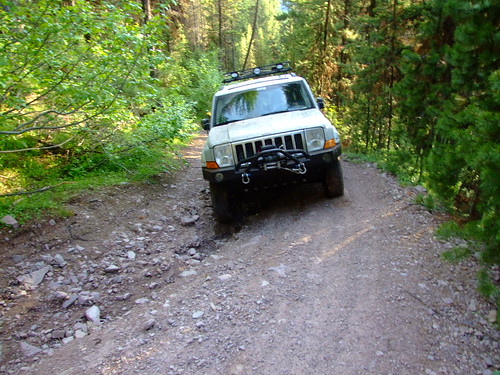
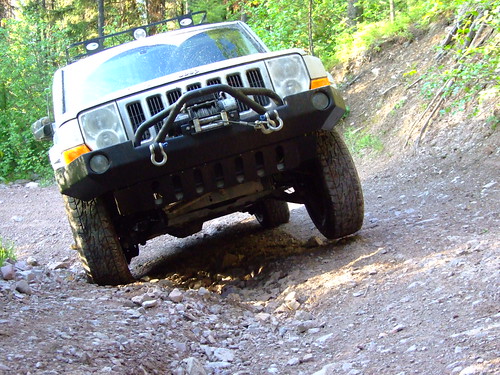
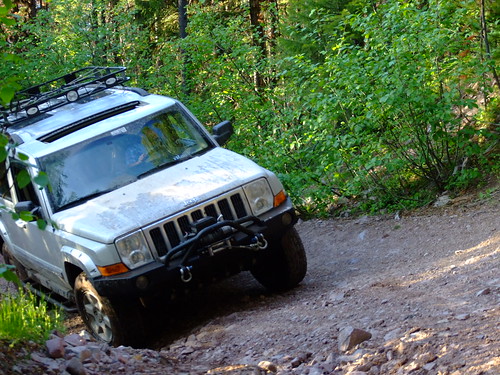
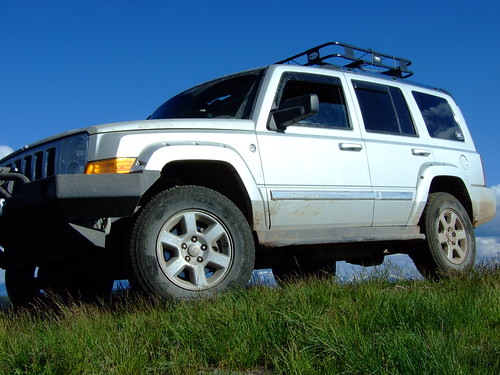
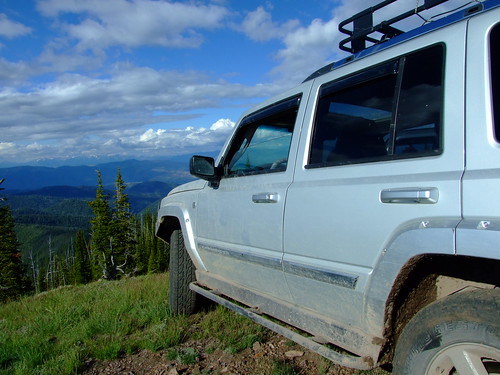
At 1445 we arrived at our lunch spot by our Geocache "Birdhouse in Your Soul" which sits on a little hill top up in the mountains. Most of the road to it is hard packed dirt and is passable by any regular car. It's bumpy, but nothing more than that. The last 1/2 mile to the cache site is a bit rougher, requiring at least moderate clearance and traction (Subaru Outback? Maybe, if you're REALLY good). The start of the 1/2 mile is relatively steep and has a significant "tire-eater" washout the switches sides, making the "straddle" technique harder to employ. The Commander doesn't even work getting up the hill.
Once on top, we had some sub-sandwiches for lunch and made sure our cache was still intact - it was. The cache itself is a birdhouse that is modified NOT to hold birds, but instead holds a little canister for do-dads, trinkets and log for others to sign. From the look of the cache, the birds were intrigued by the fake house and wanted in! Too bad, there was no vacancy.
Next, we started our trip back into the mountains. The trail varies from relatively wide (Jeep and a half) to narrow (barely a Jeep). As we climbed up through the forest, we startled a black bear wandering on the road. He did a double-take looking at the Jeep and then scampered off into the woods. The trail appeared to have been moderately cleared earlier this year and there were numerous trees cut in half to allow passage down the trail. Early on, we found a few mud-holes to splash in and placed a "protective coating" of mud on the Jeep. The trail went up and down through over the mountain ridges.
The terrain on the trail varied between packed dirt and mud slicks in the lower areas, to knotty root covered trails heading up the hills to sharp, loose rocks near the tops. The inclines and declines exhibited the same terrain variances, ensuring that we were never bored. At no time did we require 4LOW to get up or down anything, but we did employ it in order to save on the braking. Sometimes, the trees reached out to touch the Jeep and would often poke their branches through the open windows to say, "Hello."
http://farm3.static.flickr.com/2481/3639997203_6daeaace83.jpg
Some of the turns were tight and had us feeling tippy, but we managed to get by without rolling over. After a couple hours of weaving through trees, around sharp rocks, and over roots, we arrived at the top of yet another hill. It was a nice place for a campsite, but we weren't planning on staying overnight. We planted a Geocache to bring challenge some of the local cachers and then continued on up and down the road.
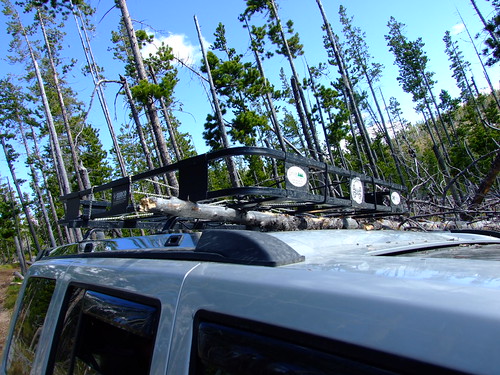
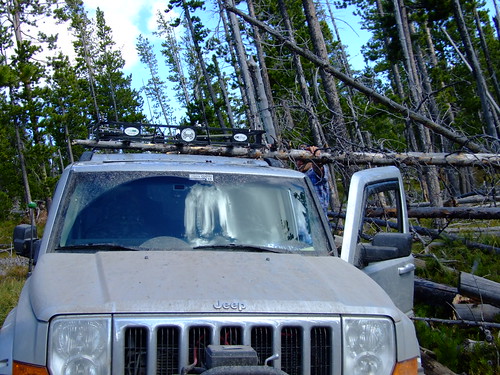
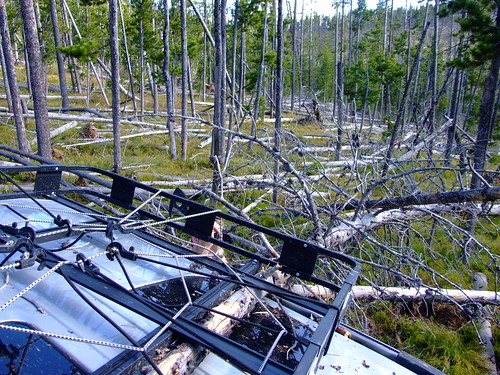
The trail narrowed as we headed down into a valley and there were dead trees all around us. The area we were in had been severely burned many years ago and the dead trees were like pick up sticks around us. Some had fallen across the road and been cut in half, others hung precariously over us as we motored through. I think the majority of the users of these trails were ATV riders, because there were times when the cut trees were just barely wide enough to allow us through. Too often, the overhanging branches would catch on the bunjee cargo net in the Surco roof rack - note for future reference: remove cargo net before going out into the forest.
It was in this area we experienced our first bit of trail damage. One of the overhanging trees - four inches in diameter - managed to hit the Jeep at just the right spot to slip UNDER the roof rack instead of sliding neatly over like the rest. The crunching and cracking sound alerted us to the problem, but the damage was done. The thick tree branch had popped some of the securing plates of the roof rack out and pushed the whole thing at a funny angle. We stopped the Jeep and got out. It wasn't pretty. If we tried to back out, the branch wanted to scratch the moon-roof glass because of the pressure it was under. We had no choice but to chop it off. With the combat axe, it only took a few minutes to get halfway through the tree, which was also cracking on its own because of the pressure against it. I had to be cautious because I knew that once I chopped through it, it would spring back a bit - and that could be dangerous.
I went around to the other side of the branch so that when it broke, it would push away from me. While I did so, my wife decided to help out and began chopping at it. She only gave it a few swing before it broke free and sprung back at her. Only her lightning-quick reflexes saved her from getting knocked-out - at best - or seriously injured by the branch. It didn't just spring back a few inches, but rather about two feet. She managed to lean back just in time to watch the branch go sailing over her head.
Having narrowly avoided much pain, we removed the offending branch from under the roof rack and did our best to get it back into place and not rattling. At least two of the bolts holding the rack in place were bent almost in half. Nothing was broke too bad and it doesn't even rattle.
Not too much further down the trail and we climbed up a steep incline to arrive at the top of small knoll. The view was fantastic all around. There was another trail leading down the opposite side of the knoll, but it was about 1900 and we had no idea where it went - it could have taken us back into town, or it could have just wound us around the mountains some more. Without camping gear and more supplies - and with three kids in back - we couldn't risk not getting back to civilization and so we turned back the way we came.
If you look close, you can see snow capped mountains under the Jeep in the background.
The trail was easier on the way back, although some of the inclines were rougher going up than coming down. While we were trying to avoid another wheel-eating washout, one fallen log took a swipe at the Jeep, putting some new scratches on the rear passenger flare, missing the tire, but punching the plastic behind the tire all the way to inside the bumper. I had to use the ax to pry it back out of there.
We arrived back home at 2200 after our little exploration into the hills. Next time, we'll leave earlier and bring camping gear - just in case. In fact, my biggest concern wasn't ever getting stuck, but ripping out one of the tires with a sharp stick or rock. I only have one of the original Forteras for a spare for the time being.
More trail damage!
This afternoon, after hosing the mud off, I noticed that my "Signal Frog" antenna topper lost his antenna!
Monday, May 25, 2009
Recovering a Dodge 4x4 from Blue Mountain
It's been a long winter, and we were itching to get out and explore Blue Mountain. We also had some caches to check on, so we planned for today to go out, check on our caches and have some fun in the mountains (aka find some trails). We packed up a pic-nic lunch after breakfast and headed for the hills. Blue Mountain is just south west of Missoula, MT and so it didn't take any time to get to the bottom of the mountain. There are numerous recreational activities on Blue Mountain, like folf in the Summer and sledding in the winter, but those areas of the mountain are right near the bottom and are usually full.
The real fun starts further up past the observatory (about nine miles from the bottom of the mountain). Usually the gate to the observatory is closed, but when we came upon it today, it was open! We were excited to get up there, but were soon stopped by the ice and snow covered road. Normally, a little slipping and sliding would be no big deal, but when you only have three feet on either side of the trail to play with, you take fewer chances. We plowed through one snowy section and the rear end of the Jeep slid sideways so we didn't continue on, decided that discretion was the better part of valor in this case, and backed out. Then we continued up Blue Mountain road towards the Woodman Saddle, an intersection of dirt roads that are used by the Forest Service and utility companies to maintain their areas. We didn't actually make it to the Saddle.
A few miles beyond the Observatory turn off, we came upon another part of the road that was snow and ice covered, but the road was wide enough to plow through. Our adventure was detoured by the sight of a red Dodge 4x4 perched precariously on the wet, muddy, edge of the trail. We stopped a safe distance away and went to investigate the truck and to see if we could render assistance.
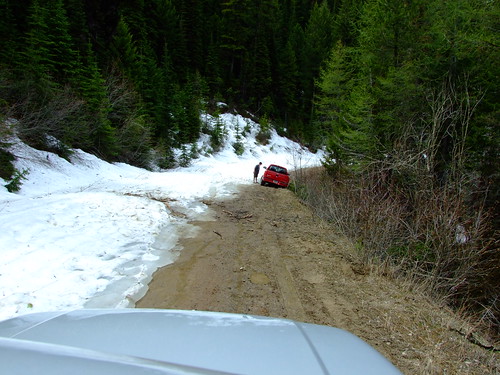
The truck was empty and there was no contact information visible. It was dangerously close to sliding over the edge and down the ravine. It wouldn't have slid TOO far (maybe 50 feet), but it very well could have rolled over a couple times on the way and made for a very bad day for someone. We looked around the Dodge, with "Got God" plates, and decided that without the owner there, we couldn't really do anything. We could stabilize it with the Jeep and Bulldog 9k winch, but we had no way of knowing when the owner would be back. It was a tough decision to make because the ground was getting softer and more saturated with water from the runoff and the Dodge was slowly (very very slowly) slipping down the embankment. While we watched it, we could see and hear that the rear driver's side tire was slowly lifting out of the mud and off the ground.
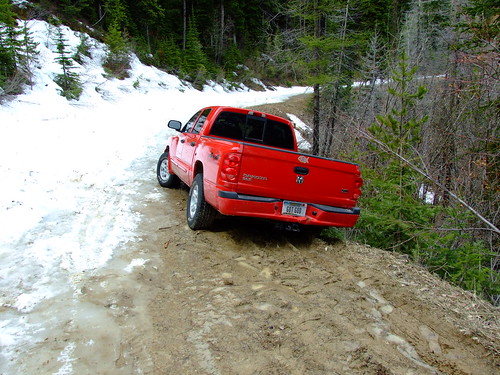
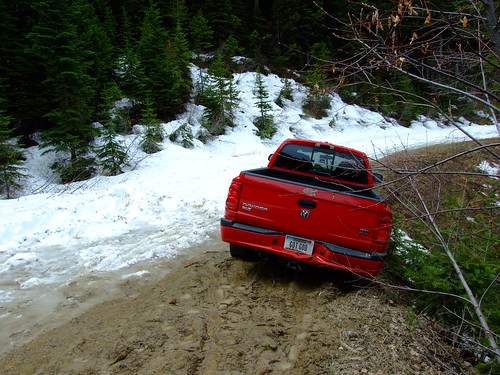
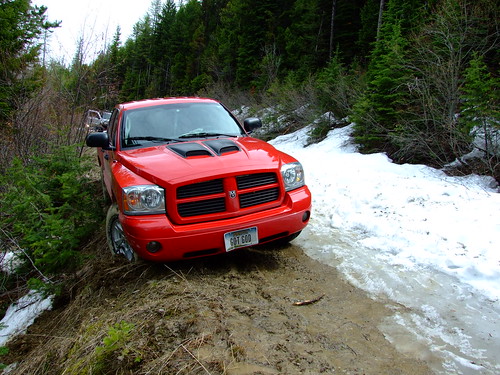
We had wanted to go around the Dodge, but decided that it was too dangerous. If the back end slipped, like it had before, we could have bumped the Dodge, sealing it to "Total Loss" insurance claim and a HUGE recovery bill. Instead, we went back down the mountain about one-half mile and found a nice spot for lunch on top of a small hill. I left a note in our Jeep window in case the Dodge owner came back and happened to see it. Then we went and found a Geocache nearby and returned to the Jeep. Just to be certain we couldn't help, we decided to go check on the Dodge before heading home.
When we got back to the Dodge, there was another truck nearby and some people walking back from imperiled Dodge. I got out of the Jeep to see if they were with the stuck truck - and they were. The first thing they asked was whether or not we could give them a hand with our Jeep and winch. We agreed to help and moved the Jeep into position on some clear (not icy and snowy, but still muddy) ground behind the Dodge and hooked the winch up. My wife pointed out that they should probably stabilize the front end of the Dodge to an uphill tree, but they decided not to.
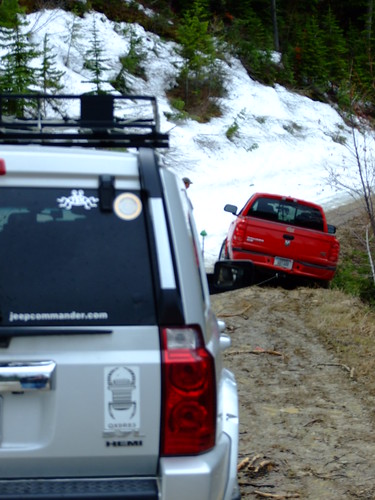
When I started to pull the Dodge back, the front end started to slide. THEN they decided that it might be wise to stabilize the front end to an uphill tree with some tow ropes. The Dodge owner first attached the ropes to his truck onto something behind the tire ("A" bracket?). My wife told them it wasn't a good place to attach the ropes to, but again, they knew best. With the truck stabilized, we winched backwards a few inches and realized we needed to move the stabilization point because the tow rope was putting a lot of forward stress on the front driver's side tire. The frame didn't have any good spot to attach a hook to, but I had the tow cluster in the Jeep too and was able to use that to hook the tow ropes up to some holes in his frame. With the Dodge stabilized, we just started winching it back. The Bulldog worked like a charm and pulled the Dodge back up onto the road. The Jeep slipped a little, so we stabilized it too. It was a bit worrisome at some points because the Dodge seemed almost certain to be heading over the edge. I was also concerned that it might try and take the Jeep with it, but, there were no other options (and I was ready to put the winch in free-spooling if I needed to).
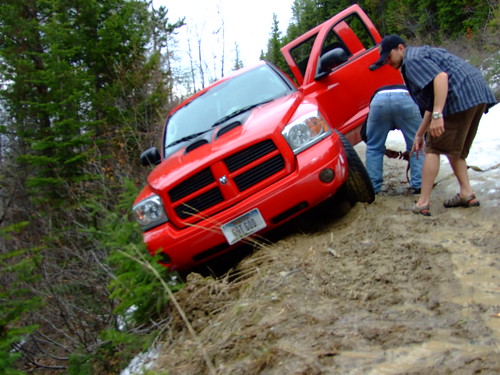
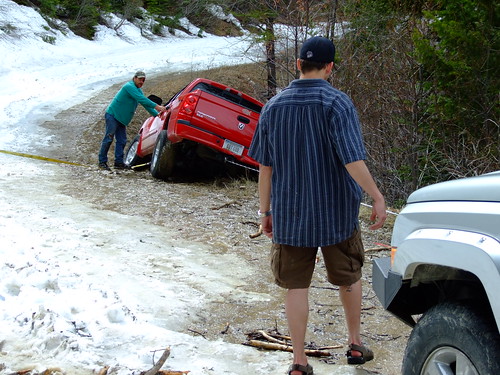
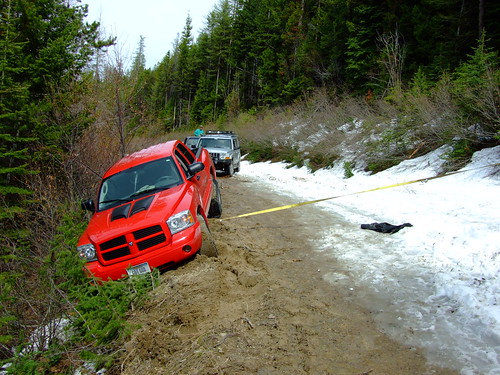
(My wife's "told you so" look when they decided to stabilize the front of the Dodge and there is a similar one when they moved the attachment point).
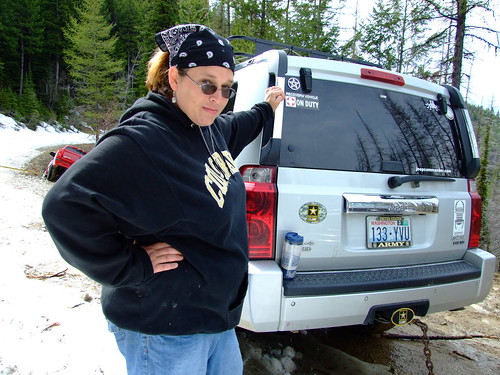
After some scary moments, we finally got it back on solid ground. It was able to drive down the mountain under its own power. Today the mountain lost a Dodge meal, and the Commander once again comes out on top.
The Flying Spaghetti Monster saves the day!
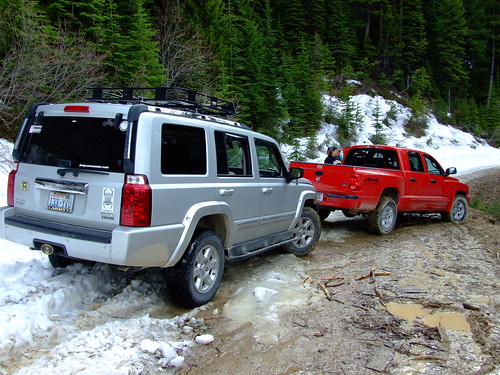
How'd he get in that predicament?
For whatever reason, he tried to go up the trail at midnight on Saturday. He got stuck in the snow and when we tried to back out he slid across the road and to the edge. I don't know how he got down the mountain.
The real fun starts further up past the observatory (about nine miles from the bottom of the mountain). Usually the gate to the observatory is closed, but when we came upon it today, it was open! We were excited to get up there, but were soon stopped by the ice and snow covered road. Normally, a little slipping and sliding would be no big deal, but when you only have three feet on either side of the trail to play with, you take fewer chances. We plowed through one snowy section and the rear end of the Jeep slid sideways so we didn't continue on, decided that discretion was the better part of valor in this case, and backed out. Then we continued up Blue Mountain road towards the Woodman Saddle, an intersection of dirt roads that are used by the Forest Service and utility companies to maintain their areas. We didn't actually make it to the Saddle.
A few miles beyond the Observatory turn off, we came upon another part of the road that was snow and ice covered, but the road was wide enough to plow through. Our adventure was detoured by the sight of a red Dodge 4x4 perched precariously on the wet, muddy, edge of the trail. We stopped a safe distance away and went to investigate the truck and to see if we could render assistance.
The truck was empty and there was no contact information visible. It was dangerously close to sliding over the edge and down the ravine. It wouldn't have slid TOO far (maybe 50 feet), but it very well could have rolled over a couple times on the way and made for a very bad day for someone. We looked around the Dodge, with "Got God" plates, and decided that without the owner there, we couldn't really do anything. We could stabilize it with the Jeep and Bulldog 9k winch, but we had no way of knowing when the owner would be back. It was a tough decision to make because the ground was getting softer and more saturated with water from the runoff and the Dodge was slowly (very very slowly) slipping down the embankment. While we watched it, we could see and hear that the rear driver's side tire was slowly lifting out of the mud and off the ground.
We had wanted to go around the Dodge, but decided that it was too dangerous. If the back end slipped, like it had before, we could have bumped the Dodge, sealing it to "Total Loss" insurance claim and a HUGE recovery bill. Instead, we went back down the mountain about one-half mile and found a nice spot for lunch on top of a small hill. I left a note in our Jeep window in case the Dodge owner came back and happened to see it. Then we went and found a Geocache nearby and returned to the Jeep. Just to be certain we couldn't help, we decided to go check on the Dodge before heading home.
When we got back to the Dodge, there was another truck nearby and some people walking back from imperiled Dodge. I got out of the Jeep to see if they were with the stuck truck - and they were. The first thing they asked was whether or not we could give them a hand with our Jeep and winch. We agreed to help and moved the Jeep into position on some clear (not icy and snowy, but still muddy) ground behind the Dodge and hooked the winch up. My wife pointed out that they should probably stabilize the front end of the Dodge to an uphill tree, but they decided not to.
When I started to pull the Dodge back, the front end started to slide. THEN they decided that it might be wise to stabilize the front end to an uphill tree with some tow ropes. The Dodge owner first attached the ropes to his truck onto something behind the tire ("A" bracket?). My wife told them it wasn't a good place to attach the ropes to, but again, they knew best. With the truck stabilized, we winched backwards a few inches and realized we needed to move the stabilization point because the tow rope was putting a lot of forward stress on the front driver's side tire. The frame didn't have any good spot to attach a hook to, but I had the tow cluster in the Jeep too and was able to use that to hook the tow ropes up to some holes in his frame. With the Dodge stabilized, we just started winching it back. The Bulldog worked like a charm and pulled the Dodge back up onto the road. The Jeep slipped a little, so we stabilized it too. It was a bit worrisome at some points because the Dodge seemed almost certain to be heading over the edge. I was also concerned that it might try and take the Jeep with it, but, there were no other options (and I was ready to put the winch in free-spooling if I needed to).
(My wife's "told you so" look when they decided to stabilize the front of the Dodge and there is a similar one when they moved the attachment point).
After some scary moments, we finally got it back on solid ground. It was able to drive down the mountain under its own power. Today the mountain lost a Dodge meal, and the Commander once again comes out on top.
The Flying Spaghetti Monster saves the day!
How'd he get in that predicament?
For whatever reason, he tried to go up the trail at midnight on Saturday. He got stuck in the snow and when we tried to back out he slid across the road and to the edge. I don't know how he got down the mountain.
Sunday, November 09, 2008
Tax Exemption vs. Free Speech
This issue comes to light now as it appears that some churches (actually a VERY LARGE number) in California and the Mormon Church in Utah have taken great pains and made large contributions of money and man-power to support Prop 8 (Gay Marriage Ban) in California. Also, throughout this campaign there have been church leaders supporting or opposing one candidate or another. Now, there is an outcry of foul-play because churches that are tax-exempt are not supposed to be involved in political activities.
Some history on churches and taxes:
In 1953, Congress changed the tax code, specifically 501(c)3 to allow churches and other non-profit organizations to apply for and receive an exemption from paying federal taxes. The IRS website gives this little summary of the relevant code:
"To be tax-exempt under section 501(c)(3) of the Internal Revenue Code, an organization must be organized and operated exclusively for exempt purposes set forth in section 501(c)(3), and none of its earnings may inure to any private shareholder or individual. In addition, it may not be an action organization, i.e., it may not attempt to influence legislation as a substantial part of its activities and it may not participate in any campaign activity for or against political candidates."
It seems clear from the tax code that a church receives special benefits from the federal government (tax exemption) and, in agreeing to that benefit, agrees that is will not "attempt to influence legislation" and "may not participate in any campaign activity for or against political candidates."
Now we come to the crux of the issue - should churches that violate their agreement with the Federal Government by making themselves "action organizations" in a campaign or legislative action be put in jeopardy of losing that tax exempt status? Or should the government look the other way - even though those churches have clearly violated their agreement?
There are numerous sides to this argument, and I'll lay out a few here:
1. Some people argue that 501c3 is simply a way for the government to silence churches. They also argue that church speech is protected by the 1st Amendment and that the government should not be able to silence or inhibit its political speech with a tax code.
2. Others agree that 501c3 is a way for the government to silence the church but recognize that churches gain something by agreeing to it - tax exemption. These people argue that churches SHOULD NOT register as tax-exempt organizations and therefore would not be subject to the political speech restrictions. They also use the Bible to support this position with the "render unto Caesar what is Caesar's" bit.
3. Still others argue that BECAUSE churches DO violate their agreement under 501c3, they should lose their tax exempt status.
After reading up on the arguments, I agree with both 2 and 3. Churches that ask for special benefits from the government should be required to comply with the restrictions placed on receiving those benefits. There is no requirement that a Church register as tax-exempt and forfeit its speech rights - it is completely voluntary. Therefore, IF a church wants to go beyond its religious talk and venture into the realm of political influence and campaigning, it should not ALSO ask the government for tax-exemption.
In Argument 1 the church wants its cake and wants to eat it too. It wants the benefits of the tax-exempt money without strings. The government has no obligation to support churches - at all. If a church doesn't want to play by the government's rules for tax-exemption - then it shouldn't want to be tax-exempt.